

Most landing pages don’t fail because of bad design.
They fail because they don’t guide decisions.
After analyzing high-converting pages across B2B and B2C, one pattern keeps showing up:
Clarity → Trust → Action
This is not a design framework.
It’s a decision-making framework.
Clarity: “Is this for me?”
Clarity is what makes someone stop scrolling. In a few seconds, users should understand what this is, why it matters, and whether it’s relevant to them.
A strong landing page starts with a clear structure. The headline communicates the outcome — the “why.” Supporting text explains what the product is and who it’s for.
The difference is simple.
“Skincare powered by science” sounds good, but says nothing.
“Clear acne in 14 days without harsh treatments” works because it’s specific, outcome-driven, and easy to understand.
Clarity reduces thinking. And when users don’t have to think, they move forward.
Trust: “Can I believe this?”
Trust removes hesitation. Without it, users won’t act — no matter how clear the value is.
Today, trust requires more than surface-level signals. People know testimonials and numbers can be fabricated, so credibility needs depth.
The first layer is expected: testimonials, metrics, product visuals, and guarantees.
The second layer is what makes it believable: specificity, consistency, and real signals.
A testimonial with a name, role, and measurable result is more convincing than a generic quote. A product shown in use builds more trust than any claim.
Generic praise is ignored. Specific proof converts.
Action: “What should I do now?”
Conversion occurs when motivation exceeds friction and uncertainty.
A good landing page makes action feel easy and safe. Clear benefits increase motivation. Simple flows and minimal inputs reduce friction. Small details like “no credit card required” or “takes 2 minutes” reduce uncertainty.
The call to action should be obvious, specific, and consistent. Users shouldn’t have to decide what to do — it should be clear at every step.
Applying the framework in practice
The impact of this framework becomes clear when applied to a real landing page.
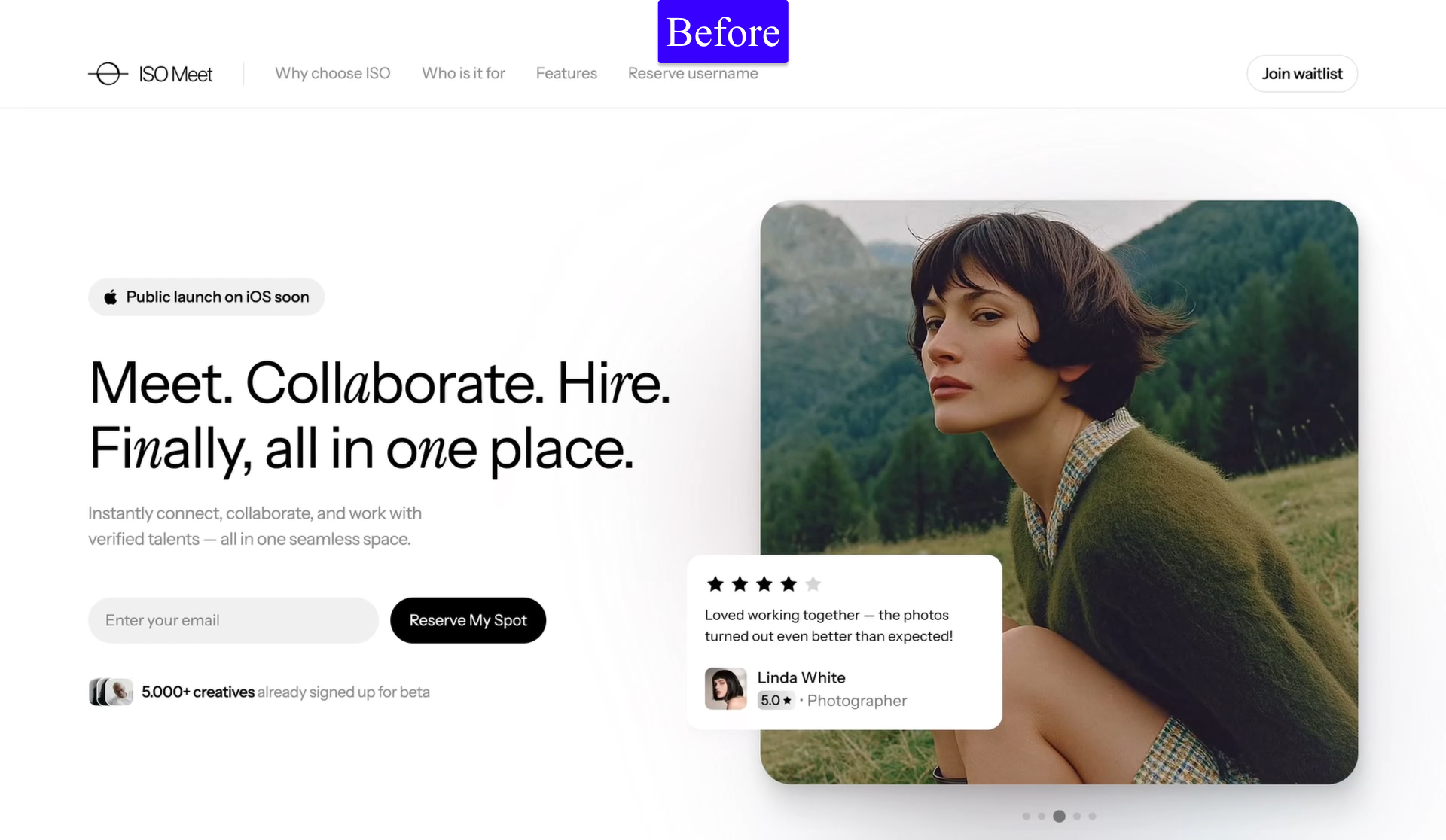
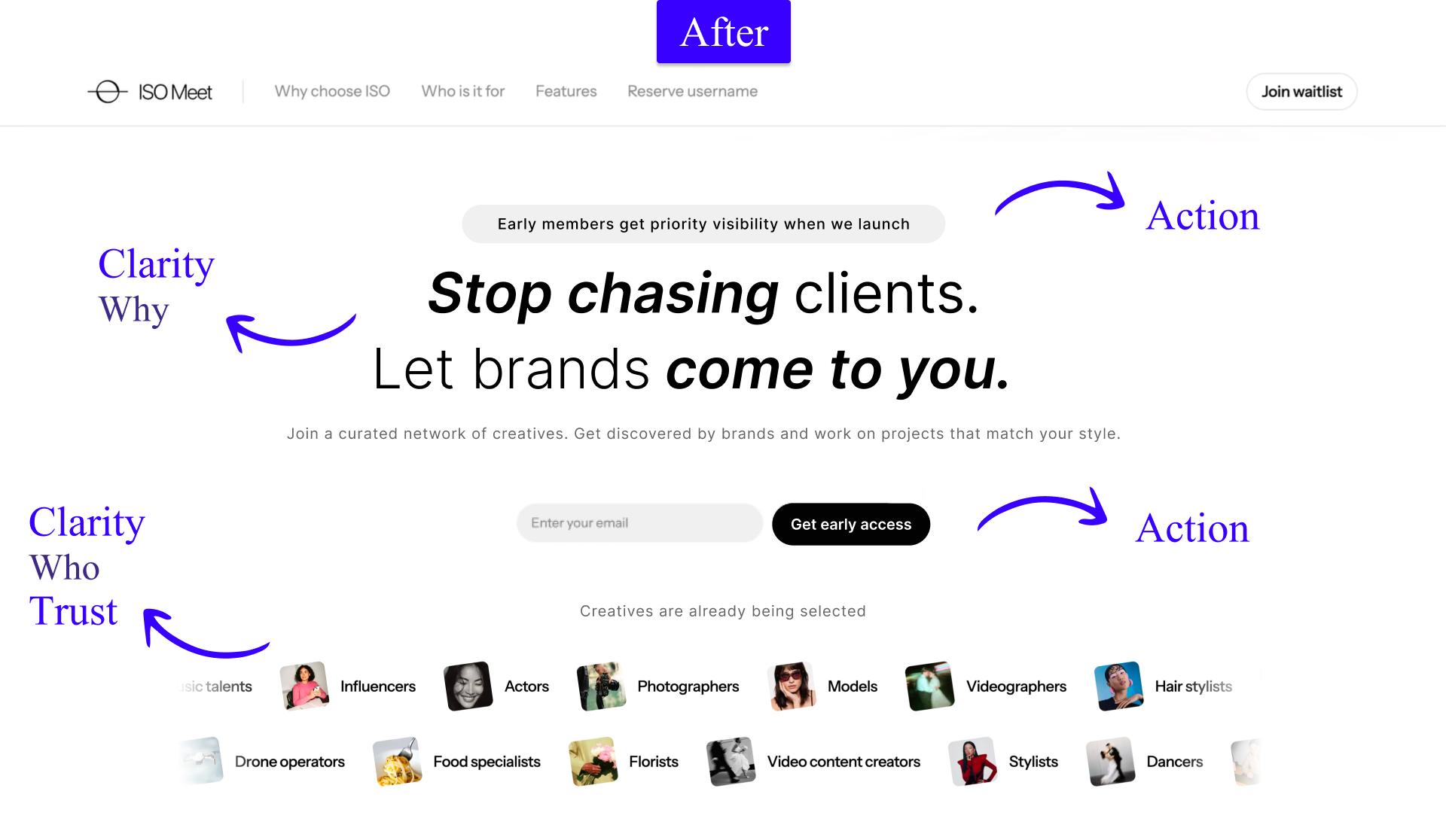
This redesign improves conversion by shifting the focus from explaining the product to guiding user decisions. Instead of generic messaging, it clearly communicates a relevant problem and outcome, helping users immediately understand that the product is for them. By introducing signals like curation and early access, it builds trust without relying on weak or generic testimonials, reducing uncertainty about the value of the platform. At the same time, simplifying the call to action and removing friction makes it easier for users to act.
Structurally, the page follows how people actually decide: first understanding, then trusting, then acting. Separating the experience into two landing pages, one for creatives and one for companies, further strengthens this approach by tailoring the message to each audience’s goals, making the value clearer and more compelling.
Additional principles to consider
Beyond clarity, trust, and action, a few practical rules amplify performance.
The 5-second rule.
Users decide almost instantly whether to stay or leave. The first screen should clearly communicate what this is, who it’s for, why it matters, and what to do next. This is not about adding more content, but prioritizing the right content and guiding attention through hierarchy.
Design is not decoration.
Design does not add meaning — it clarifies it. Color directs attention, typography improves readability, images reinforce the message, and spacing reduces cognitive effort. Good design makes the page easier to understand.
Structure matters when the page is long.
A long landing page should feel like a progression, not a wall of content. Each section should add value, remove a doubt, or move the user closer to action. The same pattern repeats: clarity, trust, action.
Final takeaway
Landing pages don’t convert because they look good.
They convert because users understand, trust, and act without friction.